

Idaho Child Car Seat Laws (2026)
Violation of Idaho child safety seat laws are a primary offense with fines starting at $100 per incident. State law mandates children under 7 must be properly secured.






Table of Contents
Table of Contents

Insurance Content Team Lead
Tonya Sisler has been a technical insurance writer for over five years. She uses her extensive insurance and finance knowledge to write informative articles that answer readers' top questions. Her mission is to provide readers with timely, accurate information that allows them to determine their insurance needs and choose the best coverage. Tonya currently leads a team of 10 insurance copywrite...
Tonya Sisler

Licensed Insurance Agent & Agency Owner
Tracey L. Wells is a licensed insurance agent and Farmers insurance agency owner with 23 years of experience. He is proud to be a local Farmers agent serving Grayson, Georgia and surrounding areas. With experience as both an underwriter and agent, he provides his customers with insight that others agents may not have. His agency offers all lines of insurance including home, life, auto, RV, busi...
Tracey L. Wells
Updated December 2024
What are Idaho Car Seat Laws
Drivers in Idaho must take appropriate steps to keep children as safe as possible on the road. There are laws in Idaho regarding the proper use of car seats for younger children as well as seat belts for older children.
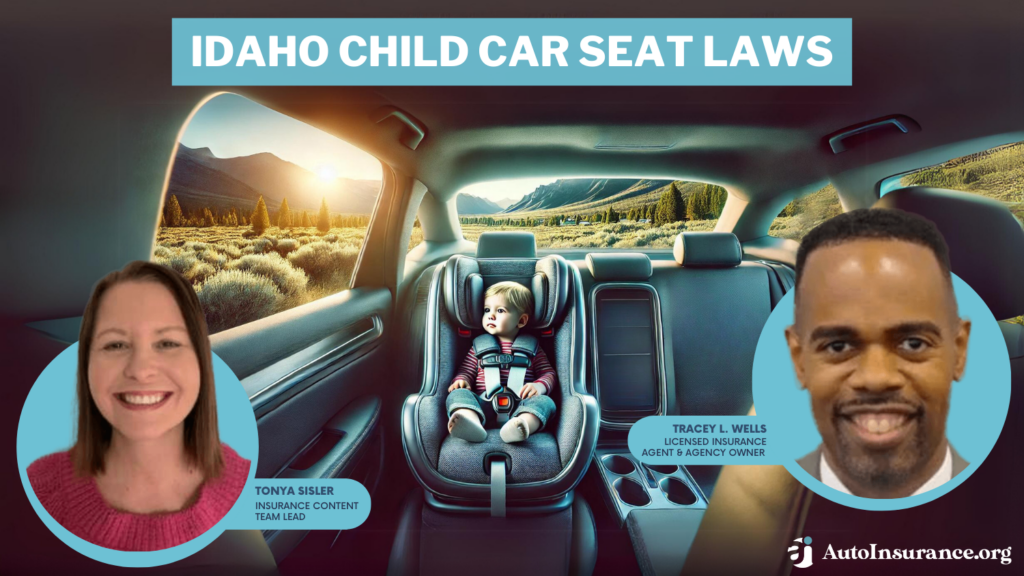
However, some drivers also refer to the American Academy of Pediatrics, or AAP, for clarification about the proper and safe use of car seats.
The AAP is a highly respected, national organization, and its recommendations apply to the general use of car seats and seatbelts. It recommends that drivers use rear-facing car seats in the backseat of the car for all children who are two years old or younger.
The AAP also recommends that front-facing car seats be used for children between the ages of two years old and eight to 12 years old who are less than 57 inches tall. There are no weight guidelines offered by the AAP for the safe use of car seats versus adult seat belts.
- The car seat law in Idaho is a primary law
- The Idaho child restraint law does not offer specific guidelines regarding when to turn a car seat from rear-facing to front-facing
- The AAP offers guidelines that Idaho drivers can follow for additional safety on the road
- Car insurance companies in Idaho will enforce their own policies on following these safety precautions
Free Insurance Comparison
Compare Quotes From Top Companies and Save
What are the Idaho Child Restraint and Booster Seat Legal Requirements
In Idaho, adhering to the legal requirement for a booster seat is essential for the safety of young passengers. Idaho’s laws specify the use of booster seats for children until they reach certain age, height, and weight requirements. This differs from the AAP’s guidelines, which provide broader recommendations.
Driving without a car seat is not only unsafe but also illegal. Those caught driving without a child seat face fines designed to enforce compliance with these critical safety measures. Ensuring that children are properly secured in their booster seats helps prevent injuries in the event of an accident.
Understanding the accident reports in Idaho can highlight the importance of adhering to car seat laws. Proper use of booster seats can significantly reduce the risk of injury during collisions. For drivers, it’s also important to be aware of the age requirement for a driver’s license in Idaho to ensure they are legally eligible to drive and are following all safety regulations.
By complying with these laws and using car seats correctly, drivers contribute to overall road safety and legal adherence.
Safety Restraints for Children Under Seven Years Old in Idaho
The Idaho car seat law requires any child who is under the age of seven years old to be secured by a car seat.
This law does not provide requirements for the use of a front-facing car seat versus a rear-facing car seat, and it does not provide recommendations for the use of car seats based on height or weight.
With this in mind, it is recommended that drivers in this state closely follow the AAP guidelines for child restraints to keep children in their vehicles as safe as possible.
Additionally, Idaho child seat belt laws are crucial for ensuring the safety of young passengers. These laws specify the use of appropriate restraints for children under seven years old, including laws for booster seats in Idaho. Following car seat guidelines is essential to ensure that children are properly secured while traveling.
For infants, car seats for infants are required to provide necessary protection. By adhering to these regulations, parents can significantly reduce the risk of injury in case of an accident.
Moreover, understanding Idaho driver’s license renewal processes and maintaining knowledge of traffic safety in Idaho are important for all drivers. Staying informed about Idaho child seat belt laws and following the appropriate car seat guidelines helps contribute to overall road safety.
Proper use of car seats not only ensures the safety of young passengers but also aligns with legal requirements, which are crucial for responsible driving and compliance with state laws.
What are the Height and Weight Requirements for a Booster Seat for Children Over Seven Years Old in Idaho
While Idaho law does not specify how long children must ride in a booster seat, for safety it is encouraged that a child use a booster seat in Idaho until weighing 40 lbs. minimum and reaching a height of 4’9″. At the age of 7, a child is not required to use a booster seat.
At the recommendation of the Idaho Transportation Department, a child, from the ages of 4-8, should ride in a backless belt-positioning booster seat. They should also stop using it when they are 4’9.”
Subsequently, Idaho’s booster seat laws set forth specific booster seat requirements to ensure the safety of children while traveling. These laws include detailed height and weight requirements for a booster seat, which determine when a child can safely transition from a forward-facing car seat to a booster seat.
Before moving to a booster seat, children must be properly secured according to the forward-facing car seat laws in Idaho. This ensures that they receive the correct protection at each stage of their development.
Free Insurance Comparison
Compare Quotes From Top Companies and Save
What are the Consequences for Breaking Idaho Car Seat Laws?
As a driver in Idaho, be aware that the car seat law and child seat belt laws are primary laws.
Note that the seat belt law adjusts to a secondary law when the child reaches the age of 18 years old.
Also, in Idaho, following car seat laws is essential for child safety and legal compliance. The Idaho seat belt code requires that all children be properly restrained in suitable car seats or booster seats based on their age, height, and weight. Failure to comply with these regulations can lead to penalties, such as a fine for not using a child seat.
This fine serves as a deterrent, encouraging parents and guardians to prioritize the safety of young passengers. Additionally, being caught without a proper car seat can result in a no car seat ticket, highlighting the importance of adhering to these safety measures.
To assist parents in meeting these requirements, programs like the USAA car seat program offer resources and support for obtaining the correct car seats. This program ensures that families have access to safe and compliant car seats, helping to avoid fines and penalties.
By utilizing such programs and following the Idaho seat belt code, parents can avoid the fine for not using a child seat and the consequences of a no car seat ticket, all while ensuring their children’s safety during travel.
What are Idaho Seatbelt Laws for Adults
Idaho’s seatbelt laws for adults are secondary, meaning law enforcement officials cannot pull drivers over solely for not wearing a seatbelt. Instead, there must be another primary violation, such as speeding, before a seatbelt violation can be cited. This contrasts with the stricter regulations for child car seats.
For example, Idaho’s rear-facing car seat laws require that infants be secured in rear-facing car seats until they meet specific age and weight criteria. These laws are part of the broader car seat rules in Idaho, which mandate the proper use of car seats for different age groups to ensure child safety.
How Do I Keep Children Safe on the Road
If you plan to drive with children in your vehicle in Idaho, it is imperative that you understand and obey the state’s car seat and seat belt laws. You should invest in the proper car seats for your children’s age, height, and weight, and you need to ensure that they are properly installed.
The National Highway Traffic Safety Administration, or NHTSA, offers special seat checks that are available to drivers free of charge.
These checks can ensure that your car seats are installed properly or can result in their adjustment so that they are installed properly.
Furthermore, to keep children safe on the road, it is essential to follow Idaho’s specific regulations and general safety guidelines. Idaho’s law for children in the front seat and Idaho’s front seat laws state that children must meet certain age and size requirements before they can legally sit in the front seat. This ensures that the airbag system, which is designed for adults, does not pose a risk to young passengers.
Additionally, the law regarding children sitting in the front seat emphasizes placing children in the back seat, which is statistically safer.
Adhering to the AAP car seat guidelines is also crucial for child safety. The American Academy of Pediatrics recommends that children use rear-facing car seats for as long as possible before transitioning to forward-facing seats and eventually to booster seats.
For vehicles equipped with built-in car seats, it is important to ensure they meet safety standards and are appropriate for the child’s age, height, and weight. By combining Idaho’s law for children in the front seat with the AAP car seat guidelines, parents can significantly enhance their children’s safety on the road.
Free Insurance Comparison
Compare Quotes From Top Companies and Save
How do I get a Quote for Auto Insurance in Idaho
Now is a great time to review your existing car insurance policy and to determine if you need to adjust your coverage to enjoy maximum benefits.
The minimum car insurance requirement per state law in Idaho only provide for liability benefits, and it does not pay for any of your own out-of-pocket expenses related to injuries that occurred in your car or repair work on your car.
If you want to ensure that children and other passengers in your car are properly covered by your auto insurance policy in Idaho, consider upgrading your coverage to a comprehensive policy that offers personal injury benefits.
Idaho drivers should get in the habit of comparing at least three to four quotes for new coverage every six months. While this can seem time-consuming, the Internet offers you a fast and convenient way to obtain quotes and to potentially identify savings on your coverage.
As important as it is to buy coverage that is affordable, you also need to turn your attention to a provider’s financial security and overall devotion to providing great customer service if you want to make a smart decision about your car insurance.
Don’t miss out on our free insurance comparison tool below! Just enter your ZIP code and compare rates now!
Frequently Asked Questions
What are the child car seat laws in Idaho?
In Idaho, the child car seat laws require all children under the age of 7 to be properly restrained in an appropriate child safety restraint system while riding in a motor vehicle. This includes the use of car seats or booster seats, depending on the child’s age, weight, and height.
What are the specific requirements for rear-facing car seats in Idaho?
Idaho law mandates that infants and toddlers under the age of 2 or weighing less than 30 pounds must be secured in a rear-facing car seat. The seat should be installed in the back seat of the vehicle and must be used according to the manufacturer’s instructions.
When can my child transition from a rear-facing car seat to a forward-facing one in Idaho?
In Idaho, children can transition from a rear-facing car seat to a forward-facing car seat once they have reached the age of 2 or have exceeded the weight or height limits specified by the manufacturer of the car seat. However, it is generally recommended to keep children rear-facing as long as possible, ideally until they reach the maximum limits of the rear-facing seat.
Are there any requirements for booster seats in Idaho?
Yes, Idaho law requires children to be in a booster seat once they outgrow the height and weight limits of a forward-facing car seat. Children must remain in a booster seat until they are at least 4 feet 9 inches tall or 8 years old, whichever comes first. It is essential to follow the instructions provided by the booster seat manufacturer to ensure proper usage.
Can children ride in the front seat of a vehicle in Idaho?
According to Idaho law, children under the age of 7 must be properly restrained in a child safety restraint system and should ride in the back seat of the vehicle, whenever possible. However, if the back seat is already occupied by other children under the age of 7, or if the vehicle has no back seat, a child may be secured in an appropriate child safety restraint system in the front seat.
When can a child stop using a booster seat in Idaho?
In Idaho, a child can typically stop using a booster seat when they reach a height of 4’9″ and are between 8 and 12 years old. However, the exact age and size at which a child can transition out of a booster seat depends on meeting both the height and weight requirements specified by the state. It is important to ensure the child is properly secured in a seat belt that fits correctly before discontinuing the use of a booster seat.
When can a child sit in the front seat in Idaho?
Idaho law recommends that children remain in the back seat until they are at least 13 years old. Although it is not explicitly illegal for a child younger than 13 to sit in the front seat, it is generally considered safer for them to be in the back seat due to the increased risk of injury from airbags and other front-seat hazards.
What is the minimum weight required to sit in the front seat in Idaho?
Idaho law does not specify a minimum weight requirement for sitting in the front seat. However, safety guidelines suggest that children should be at least 100 pounds and meet the general height and age requirements before sitting in the front seat. This is to ensure that the vehicle’s seat belt fits properly and provides adequate protection.
How old do you have to be to sit in the front seat in Idaho?
To sit in the front seat legally in Idaho, a child must be at least 13 years old. This age requirement is in place to help reduce the risk of injury from airbags and other potential hazards in the front seat area.
What are the height and weight requirements for a booster seat in Idaho?
In Idaho, the height and weight requirements for a booster seat generally follow national safety guidelines. Children should use a booster seat until they reach a height of 4’9″ and weigh between 40 and 100 pounds. This ensures that the seat belt fits properly over the child’s shoulder and lap, providing effective restraint in the event of a crash.
Can a 10-year-old sit in the front seat?
Can a 5-year-old sit in the front seat?
Can a 9-year-old sit in the front seat?
What is the fine for not using a car seat for a baby?
How much is the fine for not having a car seat?
How old does a baby have to be to use a front-facing car seat?
Is it illegal to have a car seat in the front seat?
Is it legal to ride in the back of a truck in Idaho?
Is jaywalking illegal in Idaho?
When is it legal to use forward-facing child safety seats in Idaho?
Related Articles
-
Apr 2025

Does auto insurance cover flat tires?
-
May 2026
Do you need auto insurance to drive someone else’s car?
-
Dec 2024
Does auto insurance cover you when driving abroad?
-
Apr 2025
Best Windshield Replacement Coverage in Alabama (Top 10 Companies Ranked for 2026)
-
Dec 2024
Does auto insurance cover putting in the wrong fuel?
-
Dec 2024
Does auto insurance cover hydrolock?





Get a FREE Quote in Minutes
Insurance rates change constantly — we help you stay ahead by making it easy to compare top options and save.